
As an Amazon Associate, Expert Buyer Hub earns from qualifying purchases. This guide is educational and does not contain affiliate product links.
Short answer
For most desks, a lamp in the 400 to 900 lumen range is enough. Use the lower end for laptop work and ambient support, and the higher end for reading printed documents, handwriting, crafts, or detailed tasks.
If you are choosing a lamp now, brightness is only one part of the decision. The best desk lamp also needs good glare control, a stable arm, a usable dimmer, and a color temperature that fits the way you work. For product picks, see our main guide to the best desk lamps.
Desk lamp lumens by task
Laptop and monitor work: 300 to 500 lumens
If your screen is the main light source, you usually do not need a very bright task lamp. A 300 to 500 lumen setting can reduce contrast between the screen and the room without washing out the display.
Place the light to the side of the monitor rather than directly behind or in front of it. The goal is to soften the workspace, not create a second spotlight competing with the screen.
Reading, paperwork, and handwriting: 500 to 900 lumens
Printed text and notebooks need more direct illumination than a laptop screen. A desk lamp around 500 to 900 lumens gives most people enough clarity without requiring an overhead light.
If you are older, have tired eyes, or work with small print, choose a lamp with a higher maximum brightness and a smooth dimmer. You do not need to run it at full power all day; you need enough headroom when the room gets dark.
Drawing, crafts, and detailed work: 800 to 1,200+ lumens
Detailed work benefits from more brightness, but only if the light is well controlled. A bright lamp with a poor shade can create sharp reflections and eye fatigue. For craft work, prioritize an adjustable head, wide light spread, and low flicker.
Lumens are not the same as comfort
A lamp can be bright and still uncomfortable. In our desk-lamp reviews, we look at practical factors that matter during real desk use:
- Whether the lamp creates screen glare
- Whether the head can be angled away from your eyes
- Whether low brightness settings are actually usable
- Whether the arm stays in place after adjustment
- Whether controls are easy to find in the dark
That is why two lamps with similar lumen ratings can feel very different in daily use.
Color temperature: warm, neutral, or daylight?
Brightness answers “how much light?” Color temperature answers “what kind of light?”
- 2700K to 3000K: warmer, better for evening reading and relaxed spaces
- 3500K to 4500K: neutral, often the safest range for home-office work
- 5000K to 6500K: daylight-like, useful for detail work but harsh for some people at night
If you work at the same desk morning and evening, a lamp with adjustable color temperature is worth considering. Use cooler light for focus sessions and warmer light after dark.
Placement matters as much as output
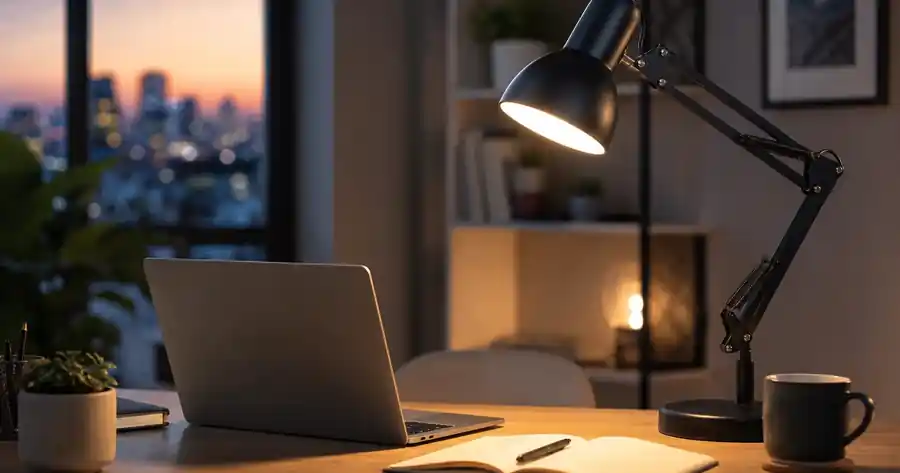
For right-handed writing, place the lamp on your left side so your hand does not cast a shadow. For left-handed writing, place it on your right. For screen work, keep the lamp slightly behind the front edge of the monitor and angled down toward the desk surface.
Avoid pointing the LED array directly at your eyes. If you can see the individual LEDs from your normal sitting position, the lamp may feel harsher than its lumen number suggests.
When to choose a brighter lamp
Choose a lamp with a higher lumen ceiling if:
- You read printed documents often
- Your office has little daylight
- You share the desk with crafts, schoolwork, or repair tasks
- You want one lamp to serve both daytime and evening use
- You prefer a dimmer but want extra range when needed
Choose a lower-output lamp if you mainly use a laptop in a small room and already have decent overhead or window light.
Bottom line
A good desk lamp for most people should offer at least 400 lumens, a comfortable middle setting around 500 to 700 lumens, and enough adjustability to prevent glare. Do not buy on lumens alone: dimming, shade design, arm stability, and color temperature often matter more after the first week.
For tested recommendations across home offices, reading desks, and compact workspaces, start with our comparison of the best desk lamps.
More in Office & Productivity



Expert Buyer Hub Team
Product Research & Testing
Our team of product researchers, testers, and editors independently evaluates hundreds of products each year. We purchase every item we review with our own funds, and we never accept free products from manufacturers. Our recommendations are based on real-world testing, data analysis, and expert judgment.