

We compared the best dehumidifiers for basements, bedrooms, laundry rooms, and damp storage spaces by looking at rated pint capacity, drainage options, tank design, noise expectations, Energy Star positioning, filter access, buyer failure patterns, and whether the machine makes sense for real homes instead of just spec sheets.
Our Verdict
The Midea Cube 50 Pint is our top pick for most damp basements because it gives you a serious 50-pint class compressor unit, a more flexible bucket design than most tall dehumidifiers, smart controls, and continuous drain support without turning the setup into a plumbing project. If you want a simple value pick, the Waykar 80 Pint Energy Star Dehumidifier has the strongest review base in this set. For bedrooms or smaller rooms, the TCL 25 Pint Smart Dehumidifier is the one we would start with before buying an oversized basement unit.
As an Amazon Associate, we earn from qualifying purchases at no extra cost to you.
Our Top 3 Picks at a Glance
Quick Comparison — All 5 Finalists
| Pick | Best for | Capacity class | Drainage | What stood out | Skip if |
|---|---|---|---|---|---|
| Midea Cube 50 Pint | Most basements | 50 pint | Bucket or hose | Flexible bucket design and smart controls | You want a basic no-app unit |
| Waykar 80 Pint Energy Star | Value for large damp rooms | 80 pint class | Bucket or hose | Very large review base and strong buyer momentum | You only need a bedroom unit |
| GE 50 Pint with Built-in Pump | Draining upward to a sink | 50 pint | Pump, hose, or bucket | Built-in pump option | You can use gravity drainage instead |
| TCL 25 Pint Smart | Bedrooms and smaller rooms | 25 pint | Bucket or hose | Compact size plus app control | Your basement is consistently wet |
| hOmeLabs WiFi Dehumidifier | Large open basements | 50 pint class | Bucket or hose | Big-room positioning and strong reviews | You hate connected appliances |
Top 5 dehumidifiers — Reviews
Our Testing Methodology
Our team reviews products by comparing practical use cases first: where the product will sit, how often it needs attention, what maintenance feels like, and where shoppers usually regret the purchase. For this guide, our criteria included pint capacity, drain setup, bucket handling, filter access, smart-control usefulness, expected noise, and whether the product is likely to fit a real basement, bedroom, or laundry room. We also checked non-competitor guidance from Energy Star’s dehumidifier category and the EPA’s mold resource hub so the buying advice stays grounded in humidity control rather than marketing claims.
We did not treat square-foot claims as the main ranking factor. They are too optimistic across the category. A damp finished basement, a leaky crawl-adjacent room, and a muggy bedroom can all need different drainage and capacity choices even if the box claims the same coverage.
Top 5 dehumidifiers — Reviews
#1 Midea Cube 50 Pint Dehumidifier — Best overall

Midea Cube 50 Pint Dehumidifier for Basement and Rooms at Home for up to 4,500 Sq. Ft., Smart Control, Compatible with Alexa (White), Drain Hose Included
- 4,500 Sq.Ft. OF COVERAGE – Midea dehumidifier with drain hose collects 50 pints of water a day and adjusts humidity from 35% to 85%. This unit is perfect for use in the basement, bathroom, bedroom, or crawlspace
- SMALLER FORM, LARGER CAPACITY – Up to 3X larger water tank allows the Midea Cube dehumidifier to operate up to 3X longer than a conventional dehumidifier. You can enjoy more time without the hassle of emptying the water tank. Removable Bucket with 4.2 Gallons/15.9L bucket size.
- DEHUMIDIFIER WITH DRAIN HOSE allows CONTINUOUS DRAIN OPTION – Versatile, no-bucket option provides more flexibility to remove moisture. You can remove the water tank and place the unit above the sink using the included drain hose, or position it over a floor drain, near a window or door.
- SMART CONTROL -The Midea Cube dehumidifiers for home are Wi-Fi enabled and can be controlled from anywhere through the cloud using the SmartHome app on iOS or Android. You can also use voice commands throughout your house, office, or apartment using Alexa or Google Assistant.
- LIFT AND TWIST- World’s first extendable dehumidifier for home offers unparalled flexibility – operate in extended or nested form. The nested design means you can easily find a place to store the unit when the space becomes dry, or extend it to its full capacity whenever you need it.
$274.99

Quick verdict: The Midea Cube is the dehumidifier we would start with for most basements because the bucket design is easier to live with than the usual tall plastic tank, and it still has the capacity and drain options people need for a damp lower level.
Skip it if: you just need light humidity control in a bedroom. A smaller 20- or 25-pint model will be easier to place and probably quieter.
Who It’s For
homeowners who want one capable dehumidifier for a basement, laundry area, or medium-to-large room and are willing to set up continuous drainage.
Pros & Cons
- The 50-pint class makes sense for basements, laundry rooms, and humid open spaces where a small unit will run constantly.
- The cube-style bucket is easier to position and empty than many narrow tanks.
- Smart control is useful here because humidity changes by season, not just by hour.
- The included drain-hose setup gives it a path to become low-maintenance once you find a floor drain or utility sink route.
- The review base for this newer ASIN is smaller than older Midea Cube listings, so we would monitor long-term reliability before calling it a forever pick.
- Smart features do not matter if your basement has weak Wi-Fi.
- The cube footprint may be awkward in a tight closet compared with a slim vertical unit.
#2 Waykar 80 Pint Energy Star Dehumidifier — Best value for large rooms

Waykar 80 Pints Energy Star Dehumidifier for Spaces up to 5,000 Sq. Ft at Home, in Basements and Large Rooms with Drain Hose and 1.14 Gallons Water Tank 80 Pints 5000 Sq. Ft
- 【80 Pint Capacity for Up to 5,000 Sq.Ft Spaces】Quickly removes excess moisture from basements, bathrooms, bedrooms, RVs, and other large living areas, delivering 80 pints per day (95°F, 90% RH).conditions. Designed as a powerful dehumidifier for basement, home, and large spaces, it helps eliminate damp air, condensation—and pet-related odors caused by excess humidity. Even during humid seasons, it works continuously to maintain a dry, comfortable, and healthier indoor environment.
- 【90° Auto Swing Airflow for Even Coverage】Distributes dry air evenly across the room, helping cover every corner and reduce uneven humidity levels. The 90° auto swing function enhances air circulation and drying efficiency, bringing a level of airflow distribution typically not available in standard models. It delivers balanced airflow without direct drafts, creating a more comfortable indoor environment.
- 【30%–80% Smart Humidity Control for Flexibility】 Unlike many standard dehumidifiers limited to a minimum of 40% RH, this unit can reach as low as 30%, offering a wider and more flexible control range. Engineered with advanced technology, it adapts to real-world conditions and maintains a stable, comfortable humidity level across different environments—including basements, bathrooms, bedrooms, closets, RVs, and other high-humidity areas.
- 【Energy Star Certified for Efficient Operation】Engineered for consistent, real-world performance, this ENERGY STAR certified dehumidifier delivers reliable results across everyday conditions—not just controlled test settings. It helps minimize unnecessary energy use while maintaining strong dehumidification efficiency, supporting lower operating costs over time.
- 【AI-Smart Protection System for Reliable Performance】Equipped with intelligent sensing technology, this dehumidifier detects frost buildup and abnormal operation in real time. It automatically activates auto defrost and overload protection to maintain stable performance and help prevent potential damage. With AI-assisted monitoring, it optimizes operation to reduce unnecessary energy use while ensuring reliable performance in low-temperature and extended-use environments.
$269.99
Quick verdict: The Waykar 80 Pint is the value pick for shoppers who want broad coverage and a large review base without jumping to a premium appliance brand.
Skip it if: the room is small, finished, and quiet. Buy a smaller unit instead of forcing an 80-pint machine into a bedroom.
Who It’s For
shoppers trying to dry a basement, large laundry room, or muggy living area without paying extra for a premium badge.
Pros & Cons
- It has one of the strongest buyer-review bases in this group, which gives us more signal on everyday use than a new model with a handful of ratings.
- The 80-pint class is a better match for open basements, garages, and larger damp rooms than small bedroom units.
- It supports drain-hose use, which matters if you do not want to empty a tank every day during humid weather.
- The value case is strong for people who need capacity first and brand-name polish second.
- Capacity claims in this category can be inflated by test conditions. We would not buy it solely because the number is bigger.
- It is not the model we would choose for a bedroom if noise sensitivity is the main concern.
- Like many high-capacity units, it still needs a sensible drain route and enough open space around the intake and exhaust.
#3 GE 50 Pint Portable Dehumidifier with Built-in Pump — Best pump model
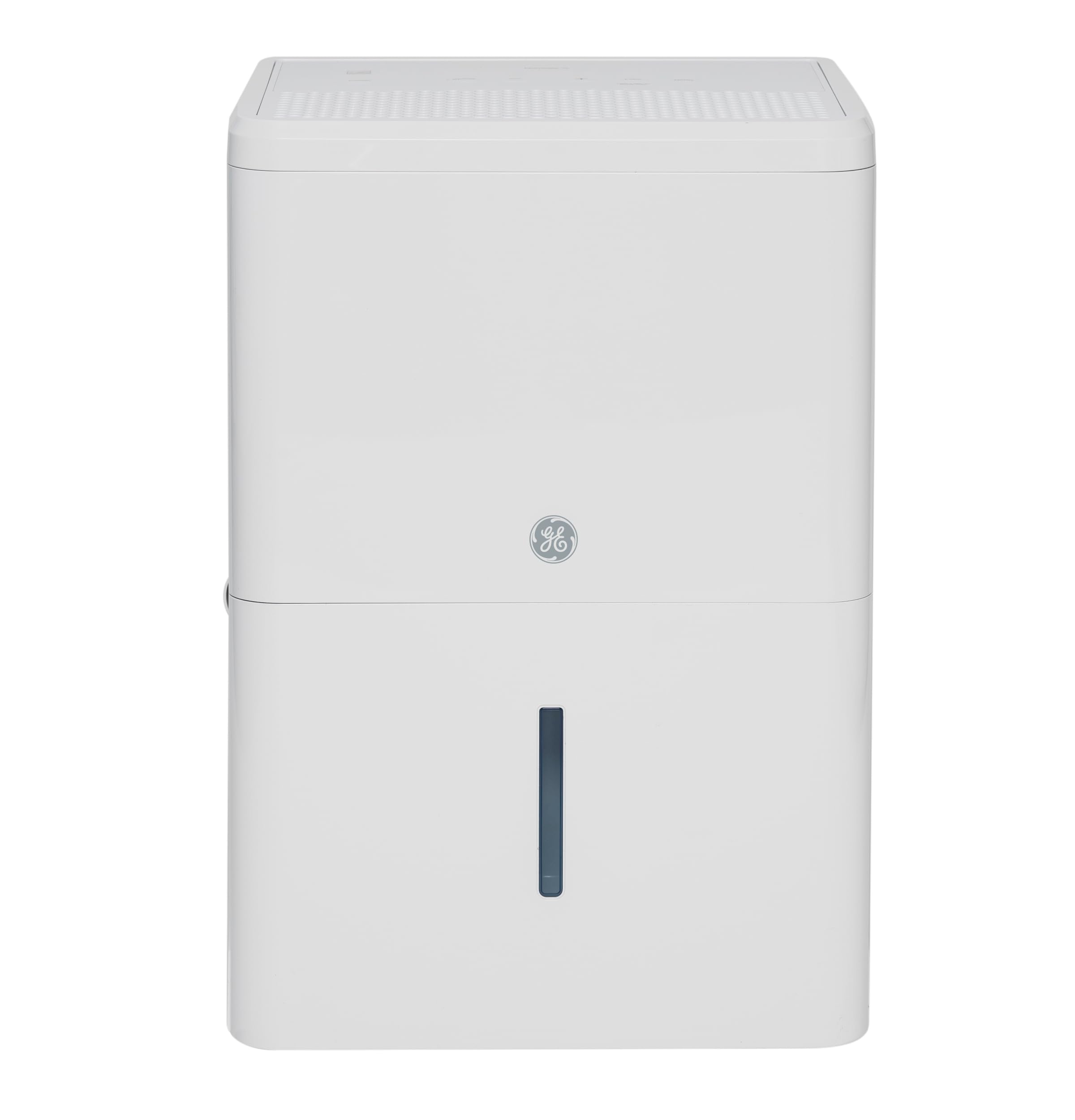
GE Portable Dehumidifier, 50 Pint Daily Output with Built-in Pump and Smart Dry for Wet Spaces Auto or Manual Drainage, Ultra Quiet, Perfect for Basement, Bedroom, Bathrooms, White 50 Pint – Pump
- BUILT‑IN PUMP FOR BELOW‑GRADE BASEMENTS – The GE 50 pint dehumidifier with pump and 16 ft drain hose moves water up to 15 vertical feet to a sink or drain when gravity won’t work, so you’re not emptying buckets multiple times a day in below‑grade spaces.
- SMART DRY TECHNOLOGY – GE’s exclusive Smart Dry automatically adjusts fan speed based on room humidity for efficient moisture removal without over‑drying, helping save electricity compared to running the dehumidifier on constant high‑speed settings.
- EASY‑TO‑EMPTY TANK OR CONTINUOUS DRAIN – Choose continuous drainage with the built‑in pump and 16 ft hose, or use the easy‑to‑empty 15 pint bucket with auto shutoff when full. Washable filter helps maintain peak performance with no replacement filters.
- FOR LARGE, WET SPACES – This portable dehumidifier removes excess moisture in areas up to 5,000 sq ft, helping keep large basements, garages, and living spaces dry and comfortable. Digital controls and an included remote let you set your preferred humidity level and schedule operation with a 24‑hour timer.
- WHEN TO CHOOSE THE PUMP MODEL – Select this built‑in pump dehumidifier if it sits below your drain, you can’t run a gravity hose, or you’re tired of emptying the tank in humid months. Helps prevent mold and musty orders in damp spaces. Portable design with pocket handles and easy‑roll wheels.
Quick verdict: The GE pump model is the practical choice when gravity drainage will not work and you need to send water up to a sink, standpipe, or higher drain point.
Skip it if: you can run a standard hose downhill. A non-pump model is simpler and usually easier to troubleshoot.
Who It’s For
anyone with a damp basement where the unit needs to drain into a sink or elevated drain rather than a floor drain.
Pros & Cons
- The built-in pump solves the most common basement problem: the drain is not always lower than the dehumidifier.
- The 50-pint class is enough for most damp rooms without making the unit oversized for every use case.
- GE’s current listing keeps the controls simple: humidity target, drainage choice, and standard portable operation.
- A pump model can save the owner from daily bucket emptying if the room layout supports it.
- Pump models add one more failure point compared with gravity-drain units.
- If you already have a floor drain, a pump may be unnecessary complexity.
- The current Amazon review count is modest, so this is a feature-based pick rather than the safest long-term reliability bet.
#4 TCL 25 Pint Smart Dehumidifier — Best smart compact pick
Sale
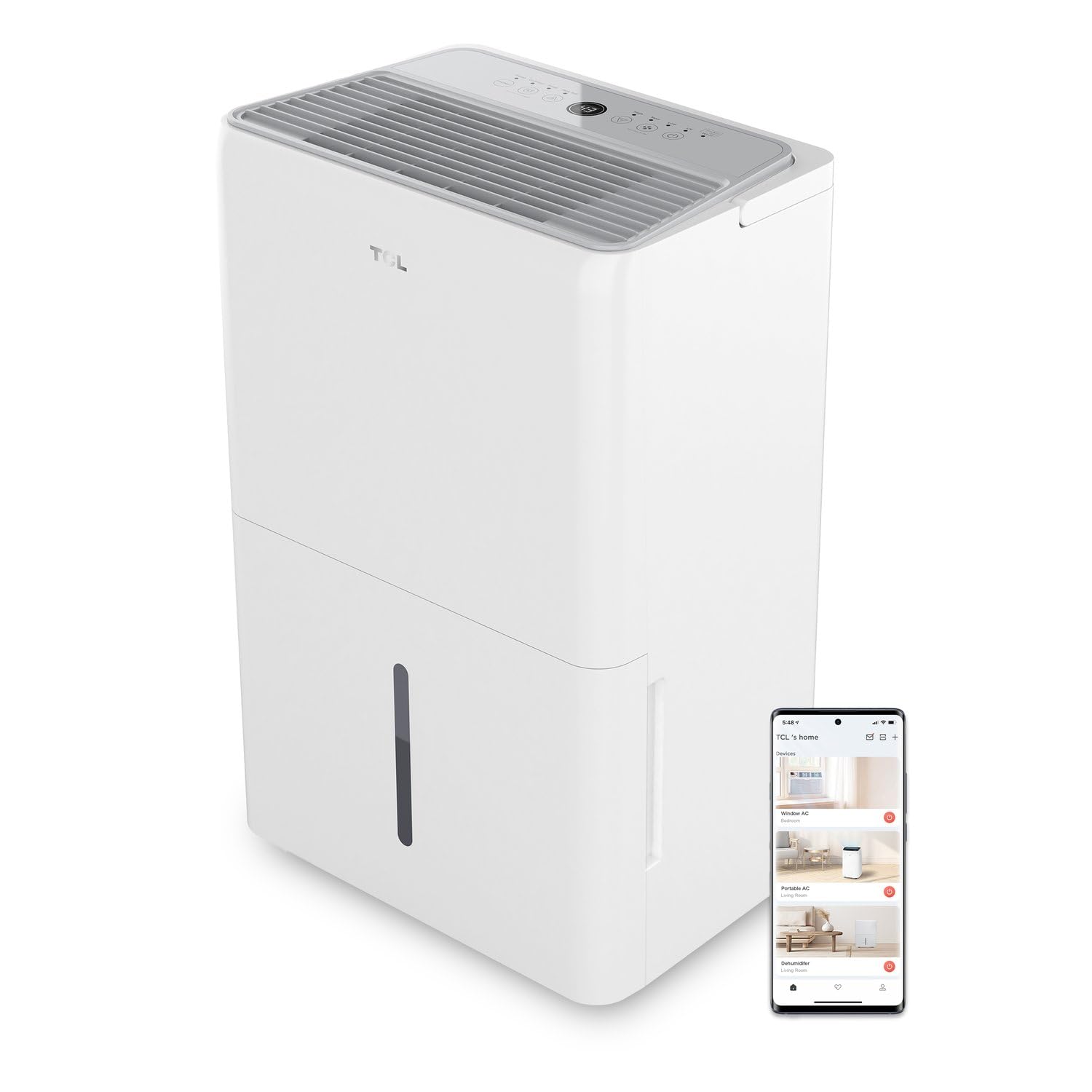
TCL 2000 Sq. Ft. Smart Dehumidifier, Energy Star Most Efficient 2024, Ultra-compact, 25 Pints Per Day, Ideal for Basements, Rooms, and Other Living Spaces, Works with Alexa/Google Assistant – H25D44W 25 Pint without pump
- 28% SMALLER ULTRA-COMPACT DESIGN: Experience unparalleled placement versatility with TCL’s new ultra-compact design without compromising powerful performance, perfect for tight living areas and basements or discreetly tucking it out of sight.
- ENERGY STAR’S MOST EFFICIENT 2024: TCL’s dehumidifier achieved Energy Star’s Most Efficient 2024 certification, representing the year’s very best for energy savings and environmental protection.
- 25 PINTS PER DAY FOR DAMP SPACES: Perfect for removing excess moisture in damp spaces, TCL’s dehumidifier can remove 25 Pints per day in spaces up to 2,000 sq.ft.*^
- CONVENIENT WAYS TO DRAIN: The easy-to-remove water bucket allows you to place your dehumidifier almost anywhere with a power outlet, while the hassle-free continuous drain port lets you connect a standard garden hose and drain directly down a drain. NOTE: continuous drain hose not included. (The dehumidifier should not be placed in an area with exposure to standing water)
- APP & VOICE CONTROL: Control your dehumidifier using the friendly TCL Home App or simple voice commands with Alexa and Google Assistant-enabled devices. For additional convenience, TCL dehumidifiers feature a control panel on top of the dehumidifier.
−$22.00
$157.99
Quick verdict: The TCL 25 Pint is the better starting point for bedrooms, offices, and smaller finished rooms where a basement-class unit would be too bulky.
Skip it if: you see condensation, musty basement odor, or repeated high humidity after storms. Step up to a 50-pint or larger unit.
Who It’s For
apartment dwellers, bedroom users, and homeowners dealing with moderate humidity in a finished room.
Pros & Cons
- The 25-pint class is more realistic for smaller rooms than buying a huge machine and running it in short, loud cycles.
- App control makes sense if the room is seasonal, such as a guest room, office, or lower-level bedroom.
- The compact format is easier to place near an outlet without dominating the room.
- It is a better fit for mild humidity than for wet-basement recovery.
- It is not the right tool for a basement that smells damp after rain.
- Smaller tanks need more attention if you do not use the drain hose.
- Smart-home compatibility is a bonus, not a reason to buy a dehumidifier that is too small for the room.
#5 hOmeLabs WiFi Dehumidifier — Best for big open basements

hOmeLabs Dehumidifier 7,000 Sq Ft Wi-Fi (50 Pint MAX 120 Pint at 95°F, 90% RH) for Home, Office, Basements with Powerful Moisture Removal, Humidity Control, Auto Shut-off, Quiet Operation 7,000 Sq. Ft
- Powerful Humidity Control – This Wi-Fi–enabled dehumidifier keeps spaces up to 7,000 sq ft comfortably dry and removes up to 50 pints per day at 80°F/60% RH (up to 120 pints at 95°F/90% RH).
- WiFi-Enabled Smart Functionality: Adjust your settings and control your dehumidifier remotely. With the cutting-edge WiFi feature, connect your dehumidifier to your home’s network and manage your comfort from anywhere.
- Stylish for Modern Homes: We’ve designed with the modern consumer in mind, providing a sleek appearance, convenient wheels and handles, and a subdued fan that won’t interfere with your quiet activities.
- Ease of Use: Simplicity at its best – adjust to your preferred moisture setting and let it operate continuously until the tank is full, upon which it will automatically shut off. For continuous drainage, a hose outlet is provided (hose not included).
- Efficient Moisture Removal: This advanced dehumidifier works through its built-in pump compressor, featuring a Turbo mode to maximize fan speed from Normal Air CFM 188 to High Air CFM 218.
Quick verdict: The hOmeLabs WiFi model is the big-room pick when you want a well-reviewed dehumidifier for an open basement and you are comfortable using a connected appliance.
Skip it if: you prefer appliances with no app account, no pairing, and no cloud dependency.
Who It’s For
homeowners with a larger basement who want remote control and a strong buyer-review base.
Pros & Cons
- The review base is large enough to give stronger signal than most new alphabet-brand dehumidifiers.
- It targets large areas and includes Wi-Fi control, which is useful for basements you do not visit every hour.
- Continuous drainage support is essential for a machine that may run heavily in June, July, and August.
- It is a sensible match for homeowners who want to track and adjust humidity without walking downstairs constantly.
- Connected controls can become a nuisance if the app is flaky or the basement has weak signal.
- Large-area claims still need common sense. Closed doors, poor airflow, and wet walls can overwhelm any portable unit.
- It may be more machine than you need for a single bedroom or small bathroom.
Related EBH Home Guides
- Best portable air conditioners for small rooms — cooling picks for apartments and bedrooms.
- Best air purifiers — improve air quality alongside humidity control.
- Best vacuum cleaners — keep damp-prone rooms cleaner between deep cleans.
What size dehumidifier do you need?
For a bedroom, office, or small finished room, start around the 20- to 25-pint class unless the space is unusually damp. For a basement, laundry room, or large open area, a 50-pint class machine is usually the safer starting point. For very damp open basements, larger 70- to 80-pint class units can make sense, but only if you also solve drainage and airflow.
If the room smells musty after rain, has visible water intrusion, or keeps returning to high humidity after the machine runs, the dehumidifier is only part of the fix. You may also need to address leaks, grading, ventilation, or drainage outside the room.
What to look for before you buy
Continuous drainage
If the unit will run daily in a basement, plan the drain route before you buy. A gravity hose needs to run downhill. A pump model can send water upward, but it adds complexity and another part that can fail.
Realistic placement
A dehumidifier needs airflow. Do not wedge it behind stored boxes or inside a tight closet unless the manufacturer allows that setup. Poor airflow makes the unit work harder and can leave the room unevenly dry.
Humidity target
Most homes feel more comfortable when indoor humidity stays roughly in the middle range rather than swinging from damp to bone dry. A built-in humidistat helps, but we still like using a small separate hygrometer to verify the room.
Maintenance
Clean the filter. Empty or route the tank correctly. Check the drain hose for kinks. Most bad dehumidifier experiences start with a neglected filter or a drain setup that never worked well.
FAQ
What is the best dehumidifier for most basements?
For most basements, we would start with a 50-pint class dehumidifier such as the Midea Cube 50 Pint. It has enough capacity for a damp lower level, supports continuous drainage, and is easier to live with than many narrow-tank designs.
Is a pump dehumidifier worth it?
A pump dehumidifier is worth it when the drain point is higher than the unit, such as a utility sink or standpipe. If you can run a hose downhill to a floor drain, a non-pump model is simpler.
Should I buy a 50-pint or 80-pint dehumidifier?
Buy a 50-pint class unit for most basements and larger rooms. Step up to an 80-pint class model only if the space is large, consistently damp, and has a practical drainage route.
Can a dehumidifier prevent mold?
A dehumidifier can reduce indoor humidity, which helps make conditions less favorable for mold, but it does not fix leaks or remove existing mold. If you see visible mold or water damage, use EPA guidance and address the moisture source first.
Are smart dehumidifiers worth it?
Smart controls are worth it for basements, guest rooms, or seasonal spaces you do not check often. They are less important for a small room where you can easily see and adjust the unit.
About the Author
Expert Buyer Hub is an independent buying-guide team focused on practical product comparisons, not press-release rewrites. Our process favors measured criteria, real-use tradeoffs, clear negatives, and Amazon links rendered through AAWP so live product data stays separate from editorial copy.
Final Verdict
Use the Amazon boxes above for live availability and product details. We preserve the editorial ranking separately from live price and availability changes.
As an Amazon Associate, we earn from qualifying purchases at no extra cost to you.
More in Home & Kitchen


Expert Buyer Hub Team
Product Research & Testing
Our team of product researchers, testers, and editors independently evaluates hundreds of products each year. We purchase every item we review with our own funds, and we never accept free products from manufacturers. Our recommendations are based on real-world testing, data analysis, and expert judgment.