
As an Amazon Associate, Expert Buyer Hub earns from qualifying purchases. This guide is educational and does not contain affiliate product links.
Short answer
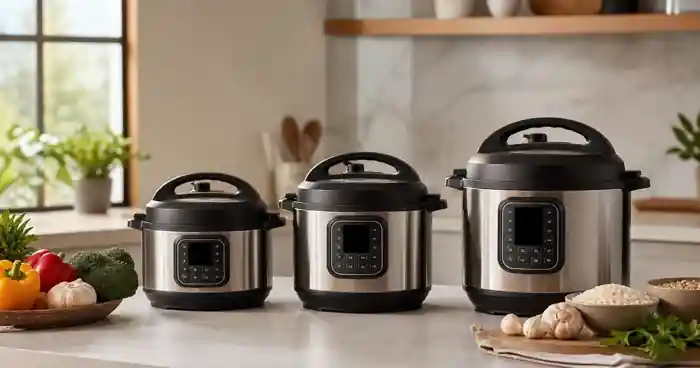
The 6-quart Instant Pot is the safest choice for most households. A 3-quart model is best for small kitchens, singles, sides, and dorm-style cooking. An 8-quart model is better for large families, batch cooking, and bigger cuts of meat, but it takes more counter and storage space.
If you are comparing specific models, see our guide to the best Instant Pot picks.
3-quart Instant Pot: best for small spaces
A 3-quart Instant Pot is compact and easy to store. It works well for oatmeal, rice, beans, eggs, side dishes, small soups, and meals for one or two people.
Choose 3-quart if:
- You cook for one or two people
- Counter and cabinet space are limited
- You mostly make sides or small batches
- You want a secondary cooker for rice or vegetables
- You dislike handling heavy appliances
The trade-off is capacity. A 3-quart pot can feel cramped for meal prep, whole chickens, large soups, or recipes written for a 6-quart model.
6-quart Instant Pot: best for most people
The 6-quart size is the default recommendation because most Instant Pot recipes are written for it. It offers enough room for family meals without becoming too bulky.
Choose 6-quart if:
- You cook for two to four people
- You want leftovers without huge batches
- You follow online pressure-cooker recipes
- You want one appliance for rice, soup, beans, meat, and yogurt
- You have normal cabinet or pantry space
For most buyers, the 6-quart model balances versatility, recipe compatibility, price, and storage.
8-quart Instant Pot: best for batch cooking
An 8-quart Instant Pot gives you more working room. It is helpful for large roasts, big soups, meal prep, or feeding a family.
Choose 8-quart if:
- You cook for five or more people
- You batch cook freezer meals
- You make stock, chili, or soup in large quantities
- You need space for bigger cuts of meat
- You have room to store a larger appliance
The trade-off is size and weight. An 8-quart cooker can be less convenient for quick weeknight cooking if you have a small kitchen.
Capacity is not the same as usable fill
Pressure cookers should not be filled to the top. Many foods need headroom, especially beans, grains, soups, and foamy ingredients. Always follow the fill lines and manual for your model.
This is one reason a 6-quart cooker often feels more practical than a 3-quart model: the usable cooking volume is lower than the total pot size.
Storage and cleaning matter
Before choosing a bigger cooker, measure where it will live. The base, lid, inner pot, steam rack, and accessories all need space.
Also consider sink size. Washing an 8-quart inner pot is easy in a large sink but awkward in a compact apartment kitchen.
Which size is best for meal prep?
For most meal prep, choose 6-quart if you cook a few days of food at a time and 8-quart if you cook large freezer batches. A 3-quart cooker is better as a helper appliance than as a main batch-cooking tool.
Bottom line
Choose 3-quart for small spaces and small servings, 6-quart for the best all-around fit, and 8-quart for larger households or batch cooking. If you are unsure, start with 6-quart unless storage space is the limiting factor.
For model recommendations, feature differences, and buying notes, see our guide to the best Instant Pot.
More in Home & Kitchen

Expert Buyer Hub Team
Product Research & Testing
Our team of product researchers, testers, and editors independently evaluates hundreds of products each year. We purchase every item we review with our own funds, and we never accept free products from manufacturers. Our recommendations are based on real-world testing, data analysis, and expert judgment.