
As an Amazon Associate, Expert Buyer Hub earns from qualifying purchases. This does not affect our recommendations or editorial integrity.
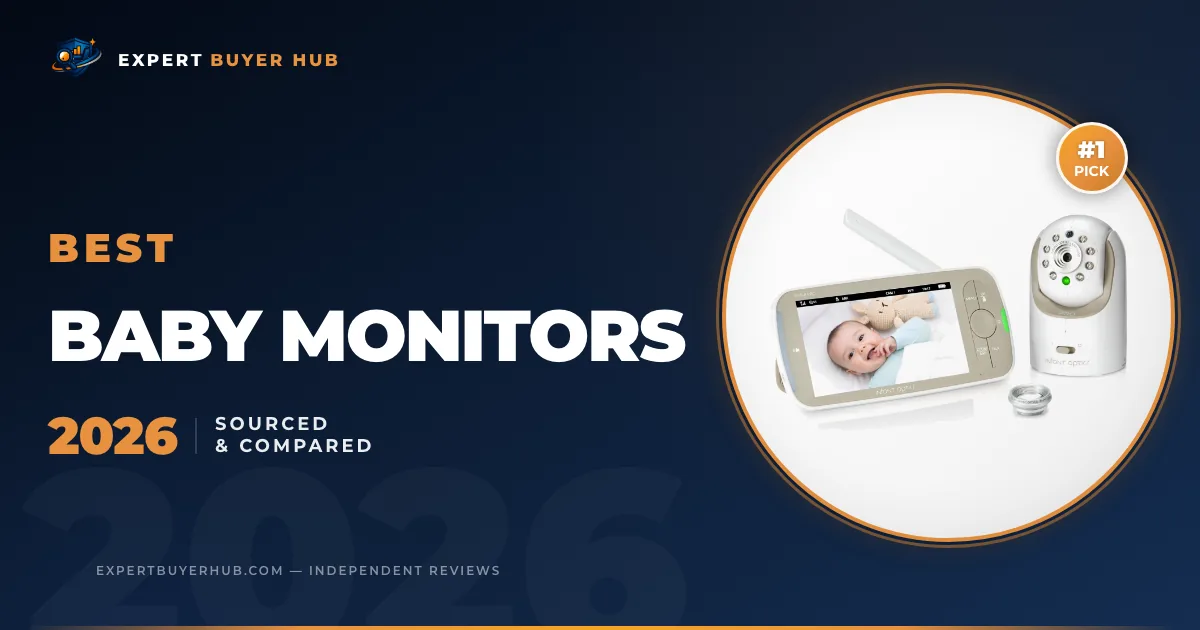
For most families who want a dedicated screen and no app dependency, the Infant Optics DXR-8 Pro is our top pick. The Owlet Dream Duo 2 adds phone-based video and narrowly defined FDA-cleared Dream Sock functions for eligible healthy infants, while the eufy SpaceView Pro E210 offers a large dedicated display and the longest manufacturer-stated battery figures in this group. None of these products replaces adult supervision, medical care, or safe-sleep practices.
Our Verdict
Choose the Infant Optics DXR-8 Pro if you want local video monitoring, a replaceable parent-unit battery, and no cloud or home-router requirement. Its 1,000-foot range claim applies only to unobstructed line-of-sight conditions, and the standard DXR-8 Pro displays one camera at a time.
Choose the Owlet Dream Duo 2 if you specifically want a Wi-Fi camera paired with Dream Sock pulse-rate and oxygen-saturation features and your baby fits the FDA-cleared intended population. Do not buy it as a SIDS-prevention device or a substitute for a clinician.
Choose the eufy SpaceView Pro E210 if a dedicated 5-inch screen and long manufacturer-stated battery life matter more than remote phone access. The camera needs continuous power, and the advertised range is not an indoor guarantee.
Our Top 3 Picks at a Glance
Quick Comparison — All 5 Finalists
Baby Monitor Comparison — Documented Features
| Model | Best fit | Connection and display | Documented range or battery | Main limitation |
|---|---|---|---|---|
| Infant Optics DXR-8 Pro | Dedicated local video | 5-inch 720p parent unit; direct 2.4 GHz connection | Up to 1,000 ft line of sight; about 6 hours screen-on or 10 hours standby | Single-camera view; no phone access |
| Owlet Dream Duo 2 | App video plus eligible Dream Sock functions | 1080p Cam 2; encrypted Wi-Fi streaming to a phone | Dream Sock sensor: up to 16 hours when new | FDA clearance is limited; not a SIDS or diagnostic device |
| eufy SpaceView Pro E210 | Longer parent-unit battery claims | 5-inch 720p parent unit; non-Wi-Fi FHSS | Up to 1,000 ft; up to 12 hours display-on or 30 hours in sleep mode | Camera requires power; no app or video storage |
| Nanit Pro | Remote app viewing and sleep features | 1080p Wi-Fi camera with app | Internet-based viewing rather than a fixed radio-range claim | Breathing motion needs patterned Breathing Wear; some insights require a plan |
| VTech DM221 | Simple audio monitoring | Audio-only DECT 6.0 parent unit | Up to 160 ft indoors or 1,000 ft outdoors; up to 18 hours | No video or app; actual range varies |
Figures above are manufacturer specifications, not EBH measurements. Maximum range and battery claims depend on conditions, settings, obstructions, interference, device age, and use.
How We Compared
This is a documentary comparison, not a hands-on test. We reviewed exact-model manuals and support pages from Infant Optics, Owlet, eufy, Nanit, and VTech. We also checked the FDA’s De Novo summary for the Dream Sock, Consumer Product Safety Commission guidance on monitor cords, and American Academy of Pediatrics guidance on safe sleep and home cardiorespiratory monitors.
- Connection: whether the monitor uses a dedicated local radio link or depends on Wi-Fi, an app, and internet service.
- Viewing: display type, video resolution, camera control, remote access, and multi-camera limits stated by the manufacturer.
- Range and battery: published maximums kept in their stated context rather than presented as guaranteed household results.
- Safety and health wording: regulatory scope, intended users, cord placement, safe-sleep limits, and manufacturer warnings.
- Ongoing requirements: camera power, compatible wearables, subscription-dependent functions, charging, and app or network reliance.
We did not independently measure signal through walls, image quality, audio delay, battery runtime, sensor accuracy, or notification reliability. Bundles and listing contents can change, so confirm the current Amazon card and manufacturer documentation before ordering. The ASINs and product order are preserved from the existing guide; manufacturers generally document models rather than Amazon ASIN-specific bundles.
The 5 Best Baby Monitors
1. Infant Optics DXR-8 Pro — Best Overall

- ACTIVE NOISE REDUCTION (ANR): Active Noise Reduction (ANR) - Patent No. [11,875,769 B2] technology which filters out fans, air purifiers, heaters, and air conditioners, so what you hear is your baby, not static.
- YOUR BABY, ONLY YOUR EYES: No WiFi. No app. No cloud. Direct Private Signal with 2nd Gen FHSS technology connects the camera straight to your monitor—without passing through a router or the internet. A private connection for everyday peace of mind.
- EASY BATTERY REPLACEMENT: Designed with real-life parenting in mind, the user-replaceable battery restores full portability and runtime in seconds. Forget battery degradation forcing you to buy a new monitor — simply replace the battery and enjoy continuous, worry-free monitoring for years to come.
- SWAP LENS IN SECONDS: The only baby monitor that lets you change lenses instantly. Use the included standard lens for most rooms or switch to the included zoom lens to catch every tiny detail from across the nursery. For a full-room view, simply add the wide-angle lens (sold separately).
- CRYSTAL CLEAR NIGHT VISION: See your baby in perfect detail even in total darkness. From your bed, simply press a button to pan, tilt, or zoom the camera — no need to open the nursery door or disturb your little one.

The DXR-8 Pro is the most balanced option here for parents who prefer a dedicated parent unit. Infant Optics specifies a 5-inch 1280 × 720 display, remote pan and tilt, digital zoom, automatic infrared night vision, two-way talk, a sound-activated LED bar, temperature display, and Active Noise Reduction. It connects directly over 2.4 GHz without an app, router, cloud account, or Wi-Fi connection.
The interchangeable lens system is useful if your room setup changes. An optical zoom lens is included, while the wide-angle lens is optional. Infant Optics notes that the wide-angle lens can introduce distortion and reduce clarity. Active Noise Reduction can help suppress steady background sounds, but the company advises turning it off if a white-noise machine makes the audio sound unnatural.
The important correction is range and multi-camera behavior. The published maximum is up to 1,000 feet with a clear line of sight and no obstruction, not 1,000 feet through a home. The monitor can pair with as many as four camera channels, but the standard DXR-8 Pro uses single view. Split-screen viewing belongs to the separate DXR-8 Pro SS model.
Who It’s For
It suits parents who want local video, physical controls, and no internet dependency. Skip it if you need to view the nursery from outside the monitor’s local radio range or need simultaneous split-screen viewing on the standard model.
Pros & Cons
Pros
- Dedicated 5-inch 720p parent unit
- No app, cloud account, or home Wi-Fi required
- Replaceable parent-unit battery
- Remote pan, tilt, zoom, and interchangeable lenses
- Active Noise Reduction and sound-level LEDs
Cons
- No smartphone or remote internet viewing
- Standard model shows one camera at a time
- Maximum range assumes unobstructed line of sight
- Wide-angle lens costs extra and can reduce clarity
Official sources: Infant Optics product documentation and the DXR-8 Pro manual.
2. Owlet Dream Duo 2 — Best for Eligible Dream Sock Monitoring

- Track key factors that affect Baby’s sleep. View Baby’s Sleep Quality Indicators like heart rate, average oxygen level, movement, wakings, humidity, room temperature & sleep status so you’re always informed of Baby’s needs.
- Receive prompts when Baby needs help getting back to sleep. Assist your baby when they may need you with Sleep Assist prompts from the Dream App and the Base Station.
- Eliminate guesswork with Predictive Sleep Technology. The Owlet Dream Sock tells you when Baby will likely need to go down for a nap, so you don’t have to worry about tracking their wake windows.
- Stream 1080p HD video with night vision to your phone. See & hear Baby over a secure Wifi connection and stay connected from anywhere. Background Audio allows you to use your phone for other tasks while still listening in for Baby.
- Watch video clips with sound, motion & cry notifications. Learn Baby’s subtle cues & behavior patterns by watching video clips that capture their behavior before they cry, wiggle, or fuss.
The Dream Duo 2 combines the Dream Sock system with the Wi-Fi-connected Cam 2. Owlet documents 1080p video, night vision, two-way audio, encrypted streaming, sound and motion notifications, crying notifications with clips, plus room temperature, humidity, and noise indicators. The Dream Sock tracks pulse rate, oxygen saturation, movement, sleep, and wakings.
The FDA clearance needs precise wording. The cleared Class II functions cover the Dream Sock’s pulse-rate and oxygen-saturation displays and Health Notifications for routine in-home surveillance of healthy infants 1 to 18 months old who weigh 6 to 30 pounds. The clearance does not turn the Cam 2, sleep coaching, or every bundle feature into a medical device. A legacy sock may also need an app-guided software upgrade before the cleared experience is active.
The Dream Sock is not intended for babies with previously diagnosed cardiovascular or respiratory conditions. It does not diagnose, treat, cure, alleviate, or prevent disease, and it does not detect or reduce SIDS or SUID. The FDA summary also warns that the system may not notify for every event; excessive movement or insufficient data can prevent a usable reading.
Who It’s For
It is for families with an eligible healthy infant who understand the labeled limits and want app video alongside the cleared Dream Sock functions. Skip it if you need a medical monitor for a diagnosed condition, want a local parent screen, or expect guaranteed alerts.
Pros & Cons
Pros
- 1080p phone-based video with night vision and two-way audio
- Cleared pulse-rate, oxygen-saturation, and Health Notification functions for the labeled population
- Sound, motion, and crying notifications
- Temperature, humidity, and noise indicators
- Dream Sock battery rated for up to 16 hours when new
Cons
- Requires Wi-Fi, an app, and regular sock charging
- FDA clearance applies only to specific Dream Sock functions and users
- Does not guarantee detection or notification for every event
- Not intended for infants with diagnosed cardiovascular or respiratory conditions
- Requires correct sock fit, alternating feet, and skin checks
Official sources: the FDA De Novo summary DEN220091 and Owlet’s Dream Duo and Cam 2 documentation.
3. eufy SpaceView Pro E210 — Best for Parent-Unit Battery Life

- Uninterrupted Vigilance: Enjoy 30 hours of default monitoring or 12 hours for intensive care with the robust battery life, ensuring the monitor endures through sleep cycles and beyond.
- Crystal-Clear Infant Watch: The sharp 720p clarity brings your baby's moments into high definition, allowing for precise visual checks at a glance.
- All-Encompassing View: With a camera that pans 330° and tilts 110°, achieve comprehensive room surveillance to keep an ever-watchful eye on your little one's activities.
- Nighttime Clarity: Rely on crisp night vision technology to observe your baby in the quiet of the night, ensuring peace of mind during the twilight hours.
- Broadened Monitoring Window: The large 5” monitor provides enhanced visibility, offering a more detailed and expansive view of your baby's safe haven.
The SpaceView Pro E210, manufacturer part T8312, is another dedicated-screen option. eufy specifies a 5-inch 720p display, 60-degree field of view, 330-degree pan, 110-degree tilt, 1.5× and 2× zoom, infrared night vision, two-way audio, sound alerts, temperature monitoring, five lullabies, and a non-Wi-Fi FHSS connection.
Its headline specification is the 5,200 mAh parent-unit battery. eufy states up to 12 hours with the display on or up to 30 hours in the default sleep mode. Those are maximum manufacturer scenarios rather than guaranteed household runtimes, and the battery is not user-replaceable. The camera itself must remain connected to its power adapter.
eufy advertises up to 1,000 feet of wireless range, but walls and interference can reduce it. The system stores no video and has no remote app viewing. It can pair with as many as three additional SpaceView cameras.
Who It’s For
It fits parents who want a large local display and long published battery figures without putting the camera on home Wi-Fi. Skip it if you need recordings, smartphone access, or a battery-powered camera.
Pros & Cons
Pros
- 5-inch 720p dedicated display
- Non-Wi-Fi FHSS connection
- 5,200 mAh battery rated up to 12 hours display-on
- Remote pan, tilt, and zoom
- Can pair with additional SpaceView cameras
Cons
- No phone viewing or video storage
- Camera requires continuous external power
- Parent-unit battery is not replaceable
- Maximum range is condition-dependent
Official sources: eufy’s SpaceView Pro documentation and the E210 product page.
4. Nanit Pro — Best for App-Based Sleep Features
- ADVANCED SLEEP INSIGHTS & AUTOMATIC TRACKING: Unlike basic audio monitors or standard WiFi cameras, this smart baby monitor acts as a sleep coach for parents, delivering everything you need as one of your baby must haves. Automatically track sleep duration, efficiency, and disturbances. . Monitor nursery conditions, cough/cry detection, and get AI-powered sleep coach insights with NextNap predictions and long-term trends to optimize your baby’s routine
- STAY CONNECTED FROM ANYWHERE: Delivering peace of mind for parents, the Nanit baby monitor with an app keeps your family synced 24/7. Live-stream 1080p HD video to your smartphone, Alexa, Google Home, perfect for grandparents and babysitters as an alternative to the smartphone app. Soothe your baby remotely with Two-Way Audio and monitor them in dark rooms with crystal-clear Infrared Night Vision.
- CUSTOMIZABLE SMART ALERTS: Get instant, customizable notifications for motion and sound detection, plus room temperature and humidity tracking, so you always know your baby is safe and comfortable. Parents can easily customize or completely turn off specific notifications at night to prevent unnecessary waking and get better rest.
- TWO WAYS TO SET UP, ONE SEAMLESS SYSTEM: Ideal for shared bedrooms or dedicated nurseries, choose versatile setup options like a floor stand or wall mount that secures easily to drywall or plaster. Access everything from the Nanit app. It's one of the baby essentials for newborns, keeping all your tools in one seamless place.
- SECURE MULTI-CAREGIVER ACCESS: Ideal for coordinating shifts among parents, nannies, and grandparents, or transitioning back to work. Add multiple users, control access permissions, and securely share your baby's precious memories . You can trust that your data is protected over your Wi-Fi network with bank-level, 256-bit AES encryption and two-factor authentication.
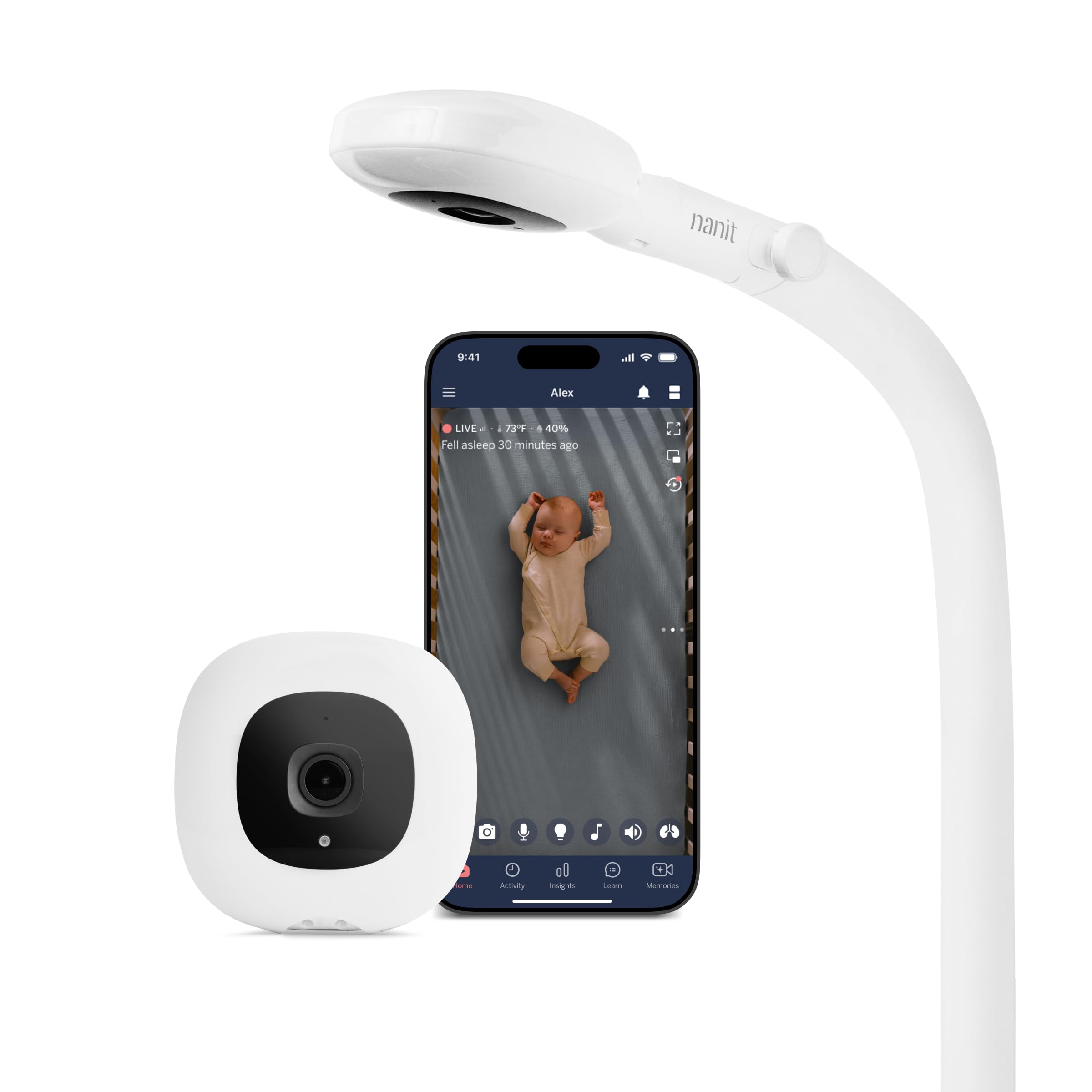
The Nanit Pro is built around an app rather than a dedicated parent unit. Nanit documents 1080p live video, infrared night vision, two-way and background audio, sound and motion notifications, temperature and humidity monitoring, 256-bit AES encryption, and two-factor authentication. It requires 2.4 GHz Wi-Fi and an internet connection.
Nanit’s breathing feature is often described too loosely. The camera tracks the printed pattern on compatible Nanit Breathing Wear, so no electronic sensor touches the baby, but the feature is not wearable-free. The pattern must remain visible. Clothing, blankets, quilts, or other bedding must not cover it. Nanit says the product is not a medical device, can produce false-positive or false-negative readings, and does not guarantee safety or prevent SIDS.
Live video, core alerts, background audio, room conditions, and two-way audio do not require a subscription. The fuller sleep-insights and video-history package does. Sleep tracking also depends on correct overhead positioning with a compatible mount, while Breathing Motion Monitoring can work with a Flex Stand under Nanit’s stated setup rules. Check the current listing carefully because stand type, included Breathing Wear, and trial terms can vary by bundle.
Who It’s For
It is for parents who want remote app access and are comfortable with Wi-Fi, an overhead setup, compatible Breathing Wear, and possible subscription costs. Skip it if you want a standalone parent screen or a medical respiratory monitor.
Pros & Cons
Pros
- 1080p video with remote app access
- Background audio, two-way audio, and core alerts
- Temperature and humidity monitoring
- Two-factor authentication and stated 256-bit AES encryption
- Core monitoring works without an Insights subscription
Cons
- Depends on Wi-Fi, internet service, and an app
- Breathing motion requires compatible patterned Breathing Wear
- Not a medical device and can produce false readings
- Full sleep insights and video history require a plan
- Mount and bundle contents need careful checking
Official sources: Nanit product documentation, Breathing Motion Monitoring documentation, and Nanit’s safety limitations.
5. VTech DM221 — Best Audio-Only Pick

- CLEAR AUDIO AND LONG RANGE - DECT 6.0 technology provides clear audio transmission, eliminating annoying background noise while allowing you to move from room to room. Up to 1,000 feet of range lets you stay connected to your baby from another room
- 5-LEVEL SOUND INDICATOR AND 2-WAY TALK-BACK INTERCOM - LEDs on the parent unit indicate the level of sound in your baby's room so you can visually monitor the noise level. The built-in intercom on the parent unit lets you talk to your baby from any room
- NIGHT LIGHT ON THE BABY UNIT - A soothing light on the baby unit gently illuminates a dark nursery. Both the parent unit(s) and baby unit allow you to turn on or off the nighlight on the baby unit
- SOUND SENSITIVITY OF THE BABY UNIT - You can choose to hear sounds from the baby unit all the time, or to hear sounds that exceed a certain level. You can use the parent unit to adjust the microphone sensitivity of your baby unit
- The parent unit runs on rechargeable Ni-MH battery or AC power. To continuously monitor your baby, make sure you use both battery and AC power at the same time. With the battery alone, the parent unit can cordlessly run for a short time only
The VTech DM221 keeps monitoring simple. It uses digitized and encrypted DECT 6.0 communication between the baby and parent units and includes talk-back, a vibrating sound alert, a five-level sound indicator, and a night-light loop. VTech rates the rechargeable parent unit for up to 18 hours of monitoring.
Range needs an indoor qualifier: the manual states up to 160 feet indoors and up to 1,000 feet outdoors. Walls, doors, building materials, environmental conditions, and nearby electronics can reduce it. VTech also acknowledges possible interference from DECT cordless phones and other devices, so “interference-free” would be too strong.
This is an audio-only system. It has no camera, app, night-vision video, remote internet access, recording, or sleep and health tracking. The baby unit uses AC power and must remain more than 3 feet from the baby, never inside or on the edge of a crib or playpen.
Who It’s For
It works for parents who only need dependable audio and want fewer screens and settings. Skip it if visual confirmation, remote phone access, or room-condition data is important to you.
Pros & Cons
Pros
- Simple audio-only setup
- Digitized and encrypted DECT 6.0 transmission
- Talk-back and vibrating sound alert
- Five-level sound indicator
- Parent unit rated for up to 18 hours
Cons
- No video, app, or remote internet access
- Indoor maximum is 160 feet, not 1,000 feet
- Nearby electronics can cause interference
- Baby unit must remain plugged in
Official sources: the VTech DM221 manual, official specification sheet, and product support.
What to Look for in a Baby Monitor
Local monitor or Wi-Fi app
A dedicated monitor works without an internet connection and keeps viewing within radio range. A Wi-Fi model offers remote access but depends on your router, internet service, app account, and the manufacturer’s software. Neither design is “hack-proof.” Use unique passwords, two-factor authentication when available, current firmware, and a secured home network.
Read range claims literally
A 1,000-foot claim usually describes favorable open or line-of-sight conditions. Indoor performance changes with walls, floors, metal, appliances, nearby radios, and the layout of the home. VTech is unusually specific here, listing up to 160 feet indoors for the DM221.
Check what needs power
Parent units and wearables may run on batteries, but many nursery cameras and baby units need continuous AC power. Plan the mounting position before buying, and route every cord well outside the sleep space.
Treat health and breathing features as supplemental information
Regulatory wording matters. The Dream Sock has specific FDA-cleared functions for a defined healthy-infant population; the whole Dream Duo bundle is not broadly “FDA approved.” Nanit states that its breathing-motion feature is not a medical device. Neither product should be used to diagnose illness, prevent SIDS, or replace safe-sleep practices and direct care.
Baby Monitor Safety
The CPSC says monitor cords should stay at least 3 feet from every part of a crib, bassinet, play yard, or other sleep environment. Never place a monitor inside or on the edge of a crib.
The American Academy of Pediatrics advises against using home cardiorespiratory monitors as a strategy to reduce SIDS risk. Continue to follow AAP safe-sleep guidance: place the baby on their back on a firm, flat sleep surface and keep the sleep space otherwise clear. A monitor does not make an unsafe sleep setup safe.
Frequently Asked Questions
Are non-Wi-Fi baby monitors hack-proof?
No responsible source can promise that a consumer device is hack-proof. A dedicated FHSS or DECT monitor avoids cloud and remote internet access, which changes the exposure compared with a Wi-Fi camera, but radio interference and device vulnerabilities remain possible.
Does the Infant Optics DXR-8 Pro show multiple cameras at once?
The standard DXR-8 Pro can pair with up to four camera channels but uses single view. Infant Optics sells the DXR-8 Pro SS as the split-screen version, so check the exact model name before buying for twins or multiple rooms.
Is the Owlet Dream Duo 2 FDA cleared?
The FDA clearance applies to specified Dream Sock pulse-rate, oxygen-saturation, and Health Notification functions for healthy infants 1 to 18 months old who weigh 6 to 30 pounds. It does not apply broadly to the Cam 2 or every feature in the Dream Duo bundle, and it does not make the system a SIDS-prevention or diagnostic device.
Does Nanit monitor breathing without anything on the baby?
No electronic sensor touches the baby, but the camera must see the printed pattern on compatible Nanit Breathing Wear. Nanit says the feature is not a medical device, can produce false readings, and cannot guarantee safety.
How far should a baby monitor be from the crib?
Keep every monitor cord at least 3 feet from every part of the crib or other sleep environment. Never put the monitor or its cord inside the crib or on its edge. Follow the manufacturer’s mounting instructions as well.
Final Verdict
The Infant Optics DXR-8 Pro is our first choice for most families because its dedicated screen, direct connection, replaceable battery, and practical camera controls cover the core job without an app. The eufy SpaceView Pro E210 is the stronger alternative when published parent-unit battery life is the priority. The VTech DM221 makes sense when audio is enough.
The Owlet Dream Duo 2 and Nanit Pro serve narrower needs. Owlet’s regulated functions require close attention to age, weight, health status, setup, and notification limits. Nanit is a flexible app monitor with sleep features, but its breathing-motion function requires patterned Breathing Wear and is not medical monitoring. In every case, choose based on the connection and viewing setup you will actually use, then follow safe-sleep and cord-placement guidance.
Related Baby Gear
Continue planning the nursery with our guides to baby strollers, baby carriers, baby bouncers, and high chairs.
About the Author
Expert Buyer Hub compares current product documentation, model-specific limitations, and independent safety or regulatory guidance. This guide was corrected and reviewed on October 3, 2026. We did not conduct hands-on testing for this update.
As an Amazon Associate, Expert Buyer Hub earns from qualifying purchases. Product availability, bundle contents, and prices can change. Check the current product listing and manufacturer instructions before buying or installing a monitor.
More in Baby & Kids




Expert Buyer Hub
Product Research & Comparisons
Our buying guides compare product specifications, manufacturer documentation, and other cited sources. They are research-based comparisons, not hands-on test reports unless an article explicitly documents its testing. Check each guide for its sources, selection criteria, and limitations.