
As an Amazon Associate, Expert Buyer Hub earns from qualifying purchases. This guide is educational and does not contain affiliate product links.
Short answer
To use a portable tire inflator safely, check the recommended PSI on the driver-side door sticker, measure pressure when the tires are cold, connect the inflator firmly to the valve stem, inflate in short intervals, and verify the final pressure with a reliable gauge.
If you are comparing inflators, focus on accuracy, hose length, auto shutoff, duty cycle, power source, and storage. For tested model recommendations, see our guide to the best tire inflators.
Step 1: Find the correct PSI
Do not use the maximum PSI printed on the tire sidewall as your normal target. That number is a tire limit, not the vehicle recommendation.
Look for the tire-pressure placard on the driver-side door jamb or in the owner’s manual. It usually lists front and rear PSI for the original tire size.
Step 2: Check pressure when tires are cold
Tire pressure rises as tires heat up during driving. For the most consistent reading, check pressure before driving or after the car has been parked for several hours.
If you must inflate after driving, treat the reading as temporary and recheck when the tires are cold later.
Step 3: Connect the inflator securely
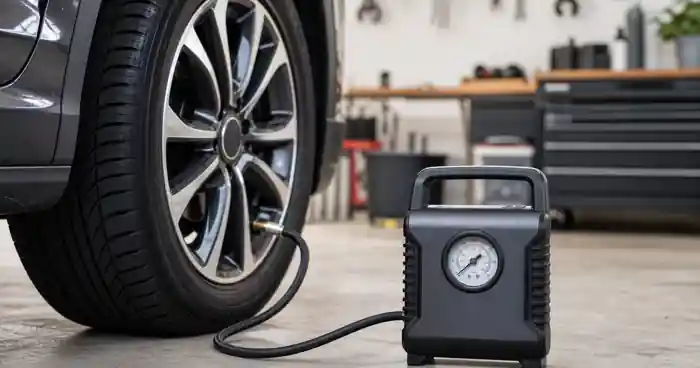
Remove the valve cap and attach the inflator hose straight onto the valve stem. A loose connection can leak air and make the pressure reading inaccurate.
If your inflator uses a screw-on connector, avoid cross-threading. If it uses a lever clamp, make sure the clamp is fully locked before turning the unit on.
Step 4: Inflate in short intervals
Set the target PSI if your inflator has auto shutoff. If it does not, inflate for short bursts and pause to check pressure.
Small portable inflators can heat up during use. Follow the manufacturer’s duty-cycle instructions. Many compact units need rest time after several minutes of continuous inflation.
Step 5: Verify with a separate gauge
Built-in inflator gauges are convenient, but they are not always perfectly accurate. For important pressure checks, verify with a separate tire-pressure gauge.
A small difference of 1 to 2 PSI is common. Larger differences can affect ride comfort, tire wear, and fuel economy.
Common mistakes to avoid
Overinflating to the sidewall number
The sidewall maximum is not the everyday recommendation. Overinflation can reduce traction, make the ride harsher, and increase uneven wear.
Ignoring the spare tire
If your vehicle has a spare, check it periodically. A portable inflator is not helpful if the spare has been neglected for years and is far below the required pressure.
Running the inflator too long
Compact inflators are not shop compressors. If you inflate multiple tires from very low pressure, allow rest periods so the motor does not overheat.
Using a weak power source
Some inflators use a 12V car socket, some use a battery, and some support both. If using a 12V unit, keep the cable clear of hot or moving parts and follow the instructions for whether the vehicle should be on.
Features that matter in a portable inflator
When we compare inflators, the most useful features are practical rather than flashy:
- Reliable pressure readings
- Auto shutoff that stops near the target PSI
- A hose long enough to reach all tires easily
- Clear display in daylight and at night
- Stable storage for hose, cable, and adapters
- Reasonable inflation speed without overheating
- Light or emergency mode for roadside use
Those factors matter more than a peak PSI claim most drivers will never use.
When not to rely on an inflator
A portable inflator can top up a low tire, but it does not repair serious damage. Do not continue driving on a tire with visible sidewall damage, a large puncture, repeated pressure loss, or signs of overheating.
If pressure drops again soon after inflation, treat it as a repair issue, not a normal maintenance task.
Bottom line
Use the vehicle placard PSI, check tires cold, inflate gradually, and verify the reading. The best portable tire inflator is not just the fastest one; it is the one that gives you controlled, repeatable pressure when you need it.
For model recommendations and comparison notes, see our guide to the best tire inflators.
More in Automotive




Expert Buyer Hub Team
Product Research & Testing
Our team of product researchers, testers, and editors independently evaluates hundreds of products each year. We purchase every item we review with our own funds, and we never accept free products from manufacturers. Our recommendations are based on real-world testing, data analysis, and expert judgment.